Sari Altschuler, Before Disability
Yesterday, June 13, was the 160th anniversary of the US Congress passing the 14th Amendment (it was ratified two years later, in 1868). The 14th Amendment is one of several important American laws on citizenship. But long before Reconstruction, early Americans were considering ideas about race, disability, and citizenship. Today we’re learning about these intertwined histories with Sari Altschuler.
If you’ve been a longtime Ben Franklin’s World listener, you might remember today’s guest from Episode 263, where she discussed her first book, The Medical Imagination: Literature and Health in the Early United States.
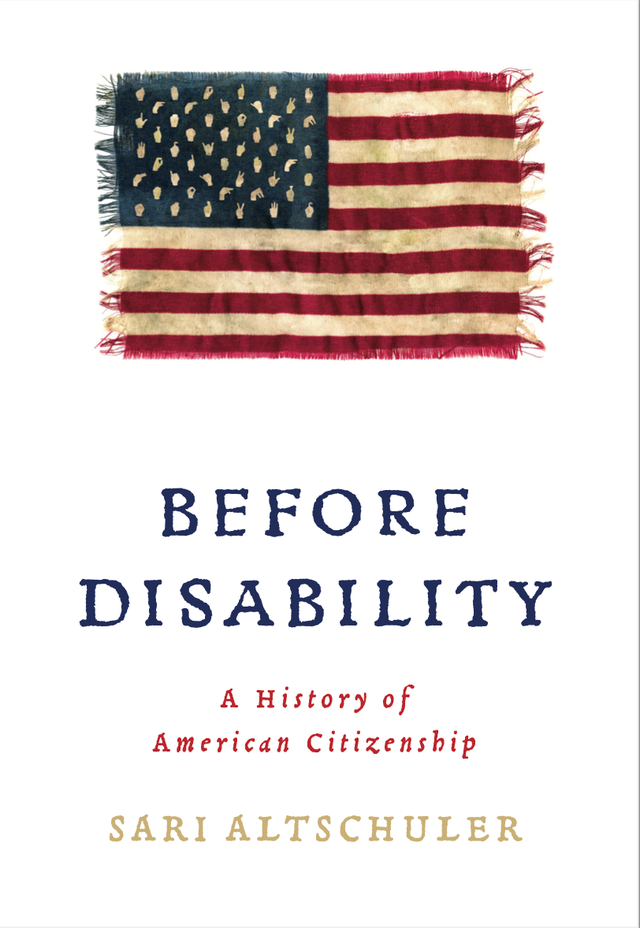
Today, Sari Altschuler is bringing us a sneak peek of her new book, Before Disability: A History of American Citizenship, which will be released on June 16. Sari is an Associate Professor of English and the Founding Director of the Health, Humanities, and Society Program at Northeastern University. Here’s Sari to tell us more about her research into disability and citizenship in early America.
Tell us about your book in two or three sentences. What's the big story you're uncovering?
This book is about the entangled history of disability, race, and citizenship in the United States between the Revolution and the Civil War. The surprise here is that a number of the differences we now call disabilities, characteristics like deafness, blindness, and madness began as accommodatable into—even exemplary of (!)—citizenship in the revolutionary and early national periods but within a few decades became powerful, racialized tools of civic exclusion, and by the century’s end, targets for eugenic elimination. Before Disability tells the story of how this dramatic transformation happened.
What first sparked your interest in this topic?
In a way, I’ve been interested in these questions since I was a little girl. My father has Type 1 diabetes and has been an advocate for people living with diabetes my whole life. Diagnosed in the 1960s, more than two decades before the ADA enshrined protections for disabled people in the law, he faced many challenges and discrimination. The diagnosis almost cost him his first job because his employer did not want the financial burden of an employee with a chronic illness, and, during the so-called War on Drugs, we learned to worry about the judgment of strangers when he used the syringes he needed to eat. At the same time, he found a calling in the decades he spent working with the American Diabetes Association, and diabetes saved him from the draft during the Vietnam War. In lieu of violence and devastation, diabetes gave him connection, community, and purpose.
I have tried to capture something of that civic complexity in this book. As he wrote in an April 2009 piece for Diabetes Forecast magazine called “The Gifts of Diabetes”: that while, of course, he would want his disease cured, “diabetes has also given me a number of gifts. Without it, my life would have been different and not necessarily better.” This book is a product of those early lessons.
What's one surprising or little-known detail you discovered in your research?
I was really blown away to learn that formal sign language* had appeared in popular plays on the New York stage sixteen years before the first schools for Deaf students opened in the United States. There had, of course, been kinds of sign language that were used within Indigenous and Deaf communities for a long time before, but in 1801 at least two New York plays made the case that it only took a little formal sign language instruction to restore the civil rights of Deaf people in America. The first school for Deaf students—the place where Americans could actually learn this kind of sign language—wouldn’t open until 1817.
* By “formal” sign language, I mean that which began with the so-called “methodized” French signs, whose explicit work was making republican citizens. Thomas Hopkins Gallaudet would bring this system back from Paris as the basis for instruction at the first school at Hartford.
Why does this story matter for understanding the early American past or the present?
This history provides a firmer grounding in the fight for disability rights and justice today. There are countless horrors in the American past, especially in the history of race and disability in the United States, and it is essential to uncover them. That said, it’s easy to begin thinking that the past only holds histories of oppression and exclusion, met at times by individual and sometimes group resistance. But the archive holds surprises on this account, and we should let it surprise us. In 2026, when so many of our nation’s foundational institutions are under threat, it seems ever more important—indeed, urgent—to recognize the structure, support, and opportunity, however imperfect and flawed, that institutions can provide and have in the past provided. Returning this unexpected history of disability, race, and citizenship to our broader stories about American history can offer a powerful platform for advocacy today.
If you could invite readers into one scene from your book, what moment would you choose and why?
One of the coolest parts to write was about Nathaniel Hawthorne’s The Scarlet Letter, which is probably the most canonical book in American literature. Most people have read this book and think they know what it’s about. What most people don’t know is that Nathaniel Hawthorne had ties to the Perkins School for the Blind and knew a lot about the new raised-print technologies for tactile reading they were developing there for blind and sighted readers. It turns out the scarlet letter is a raised-print letter hiding in plain sight! (hint: braille didn’t become a popular form for blind readers in the US until the twentieth century) The history of blindness in the US opens up a whole new way of thinking about what Hawthorne is saying about reading, about citizenship, and about the senses—specifically how he uses the romance to reimagine citizenship grounded in alternative reading practices. It’s a good example of one important strategy in Before Disability. In addition to the wide range of sources in Before Disability, each chapter also turns to a major, familiar work of American literature—The Scarlet Letter, Moby-Dick, Narrative of the Life of Frederick Douglass, and a number of others—to invite readers to think differently about American culture and the past.
What's one historical source, artifact, or place you'd recommend for readers who want to explore this topic further?
Hard to choose!
Okay, here’s what I’d recommend: David Weimer at the Newberry Library and I curated an exhibit on books made for blind readers in the US in the nineteenth-century called Touch This Page! Making Sense of the Ways We Read in collaboration with Perkins School for the Blind. We wanted to use those print forms to make people think a bit more about how they use their sense to read. Probably the coolest part is that if you have a 3D printer or access to a library that has one you can print those artifacts yourself. Just go to touchthispage.com. So, if you want to know what I’m talking about when I say the scarlet A is a “raised-print letter,” start here.
Where can readers learn more about your work?
The American Antiquarian Society is hosting a book launch on July 14, 2026 from 7-8 pm, which is hybrid. So, if people are in Worcester, MA, I’d love to meet you, and, if not, everyone is very welcome to join online! I’m also on bluesky @sarialtschuler.bsky.social

🎧 Go Deeper
Learn more about citizenship in early America with these episodes of Ben Franklin's World
🎧Episode 188: Terri Halperin, The Alien & Sedition Acts of 1798
🎧Episode 255: Martha S. Jones, Birthright Citizens
🎧Episode 076: Nathan Perl-Rosenthal, Citizen Sailors: Becoming American in the Age of Revolution