John Garrison Marks, Thy Will Be Done
Poll historians and they will tell you that contemporary issues probably have far longer histories than you realize. Today, we’re featuring a book that investigates the debate over Americans' memory of George Washington and slavery. It turns out this debate is almost 250 years old.
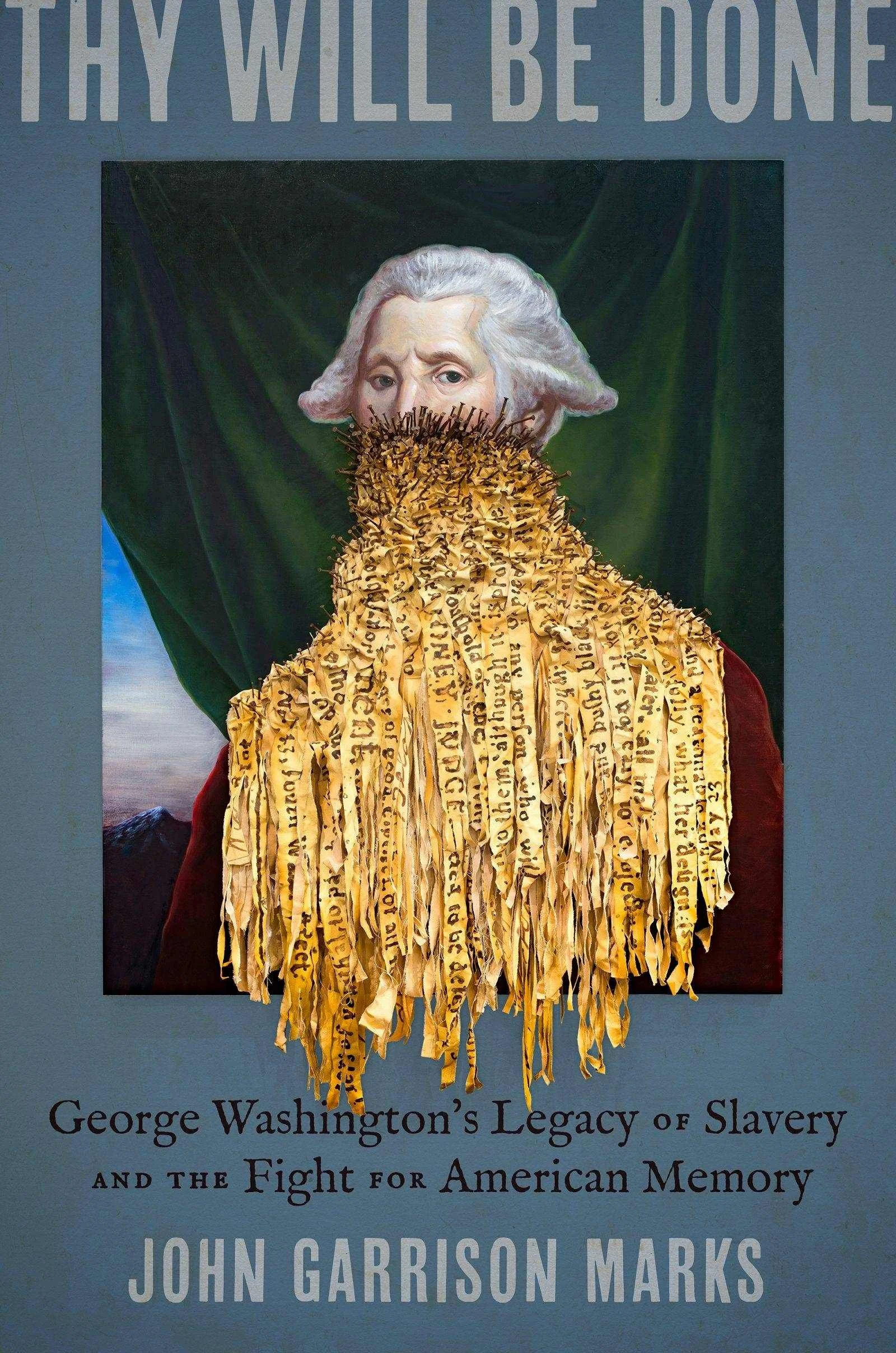
John Garrison Marks is the author of the new book, Thy Will Be Done: George Washington's Legacy of Slavery and the Fight for American Memory. John is a historian and author who also works with the American Association of State and Local History. Here’s John to tell us all about the debate Americans have been having about Washington’s legacy for almost as long as the country has existed.
Tell us about your book in two or three sentences. What's the big story you're uncovering?
Thy Will Be Done tells the story of how Americans have thought, and fought, about George Washington and slavery over the past 250 years. It’s not really a book about George Washington in the traditional sense. Instead, it’s a book about how generations of Americans—politicians, abolitionists, educators, museum curators, even the descendants of people Washington enslaved—have understood slavery’s place in Washington’s legacy and how they’ve wielded it in the political and cultural fights of their day.
What first sparked your interest in this topic?
I’ve been writing about, thinking about, and working on preparations for the 250th anniversary since 2017. As a scholar of slavery, I was interested to see how this commemoration would (or wouldn’t) grapple with the founders’ involvement in slavery. Then, in the summer of 2020, the demonstrations for racial justice sparked a new effort to really reckon with George Washington’s legacy of slavery, along with those of other prominent enslavers. These two overlapping moments—the 250th anniversary and Black Lives Matter—made me want to better understand how Americans of previous generations dealt with these questions. I came away astounded by how contentious these debates have been throughout the entirety of American history.
What's one surprising or little-known detail you discovered in your research?
The most surprising thing to me was how little the conversation about Washington and slavery has changed. The heated arguments of the last decade or so—about whether to understand Washington as a slave-owning hypocrite or an unrivaled hero—have at times felt unprecedented, but nothing could be further from the truth. The book features Americans in the 1930s, the 1850s—even one writing directly to Washington in the 1790s!—who voiced absolutely blistering condemnations of Washington for his involvement in slavery. The reality is that Americans have been arguing about how to understand slavery’s place in Washington’s legacy from the very beginning.
Why does this story matter for understanding the early American past or the present?
This story highlights how directly early America can speak to the present. This isn’t even the case of the present offering an “echo” of historical events, either. Instead, Americans today are grappling with literally the very same questions as Americans more than two centuries ago. What should it mean to us that the “father of his country” was so actively, intimately involved in the institution of slavery? What does that say about the foundation of America? What does it say about us as Americans? I hope that revealing how different generations of Americans have answered those questions helps shed light on today’s arguments and helps us better understand both Washington and ourselves.
If you could invite readers into one scene from your book, what moment would you choose and why?
In the spring of 1821, Washington’s nephew Bushrod Washington—who had inherited Mount Vernon about 20 years earlier—gathered together all the people he enslaved there to tell them, unequivocally, that he would never emancipate them. This was in contrast to his uncle George Washington, who used his will to free the people he enslaved. A few months later, Bushrod sold nearly fifty of those people to Louisiana and elsewhere in the Deep South—part of the “second middle passage,” the sale and forced migration of as many as a million enslaved people from the Upper South to the Lower South. When word of Bushrod’s actions got out in the newspapers, it set off a months-long firestorm in the American press. Northern papers brutally criticized Bushrod for betraying his uncle’s legacy, while southern papers banded together to defend him. The image of Bushrod gathering together the people he enslaved to inform them he “had no intention to give freedom to any of them”—only to afterwards complain of their “insubordination”—really defies belief. But more importantly, this episode ushered in four decades of both antislavery and proslavery forces each manipulating Washington’s history with slavery to support their respective positions. It’s one of the most fascinating stories of the book for me, and really sets up what was one of my favorite chapters to write.
What's one historical source, artifact, or place you'd recommend for readers who want to explore this topic further?
I would encourage people to visit two historic sites: one, of course, is George Washington’s Mount Vernon; the other is the Woodlawn-Pope Leighey House, just up the road. Both sites tell the story of George Washington and slavery, but they’re very different in size, resources, and approach to the story. Mount Vernon has made great strides in addressing Washington’s history of slavery, though it’s still just one story among many that you’ll find there. But there’s nothing quite like the power of place to connect you to this history. Woodlawn—which, before 1800, was part of the original Mount Vernon plantation—picks up the story where Mount Vernon leaves off and tells it in a very different way, more directly drawing connections with contemporary issues. There’s a lot to be gained from visiting both sites.
Where can readers learn more about your work?
You can learn more about me, find links to my other writing, and see where I’ll be speaking about the book on my website, johngmarks.com. You can also find me on Bluesky at @johngmarks.com, where I post far too much, or on Instagram and TikTok at @jgmhistorian. If you come to an event please say hi, and if you see my book in public please post a photo and tag me!
🎧 Go Deeper
Explore the life of George Washington with these episodes of Ben Franklin's World:
🎧 Episode 137: Erica Dunbar, The Washingtons’ Runaway Slave, Ona Judge
🎧 Episode 033: Douglas Bradburn, George Washington & His Library
🎧 Episode 385: Cassandra Good, Did George Washington Have Heirs?