Alan Mikhail, Newcomers
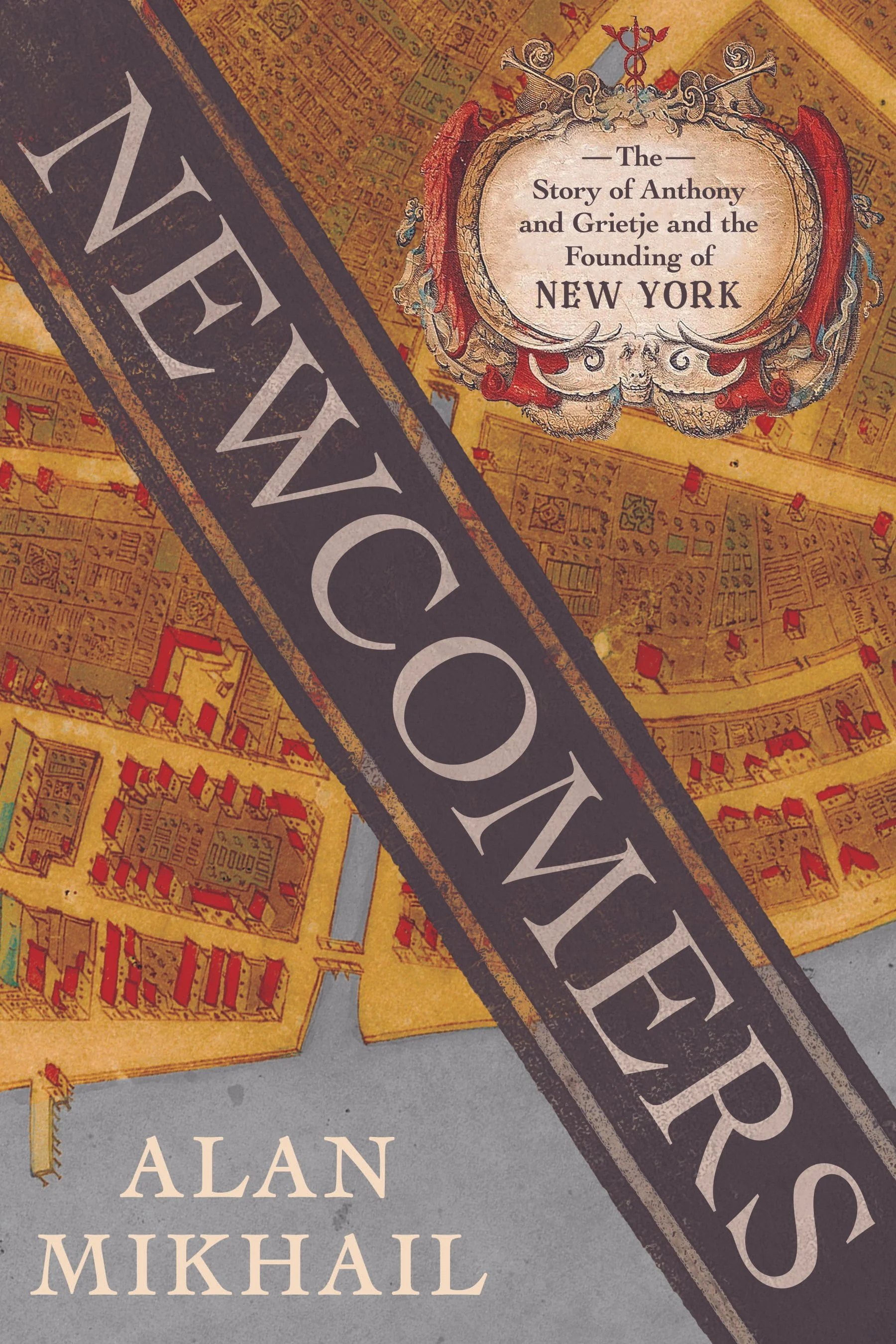
In the 1630s, two new immigrants entered Dutch New Amsterdam. Anthony and Grietje were a fascinating couple who left their mark in court cases and, in Grietje’s case, an infamous indecent exposure incident. Anthony and Grietje’s experiences also bring up serious historical questions about religion, diversity, and family in early America.
Alan Mikhail joins us today to tell us more about this couple from his book, Newcomers: The Story of Anthony and Grietje and the Founding of New York. Alan is the Chace Family Professor of History at Yale University. Here’s Alan to introduce us to Anthony and Grietje.
Tell us about your book in two or three sentences. What's the big story you're uncovering?
Newcomers is the story of Anthony and Grietje, an unconventional married couple in New Amsterdam, the colonial possession at the southern tip of Manhattan that the Dutch held from 1624 to 1664. Throughout the sources from the period, Anthony was known as a Muslim from Morocco, and Grietje was maligned as a sex worker. Although usually written off as almost cartoonish characters–the “Turk” and the “whore”–their story reveals a great deal about the early modern world, the Atlantic, and the nature of early America. In following the pair from Europe and the Mediterranean to Dutch Manhattan and eventually to Long Island, I tell a tale that represents a new family history of early America, one that involves Islam, female defiance, empire, and wealth. The book asks what it would mean to center this couple in (or even as) America’s origin story.
What first sparked your interest in this topic?
I began my life as a historian of the Middle East interested in the connections between that region and the rest of the world. This brought me to the study of Islam and the Atlantic where I first read the story of a Muslim living in Dutch New York. That was the initial hook. Could this be? Who was this Muslim in New York? I went into the research for this book wanting to learn more about Anthony. The story I found and ended up telling was substantially different from what has been told before and, I think, more complicated and more interesting.
What's one surprising or little-known detail you discovered in your research?
Anthony the Turk, the so-called first Muslim of New York City, was almost certainly not a Muslim in any conventional sense of the term. It’s impossible to know what he believed in his heart, but none of his actions suggested Islam. And, in fact, whenever he did project a religion, it was Christianity. He had a Christian marriage with Grietje, for example, and they baptized a daughter in the Dutch Reformed Church. Yet, his contemporaries, and historians since, always referred to him as a Muslim. Why would that be? This conundrum is one of the topics my book tackles. The book also offers the first account of Grietje’s harrowing early life.
Why does this story matter for understanding the early American past or the present?
It gives us a much more complicated and accurate picture of early America that allows us to imagine new trajectories toward the present. Instead of a picture of early America as only Native, European, and Black, Newcomers helps us to think about some of those other people not captured by these dominant racial and ethnic categories. It is a story of immigration and the prejudice that follows it. The book also shows how those discriminated against and shunned could also colonize and dispossess others.
If you could invite readers into one scene from your book, what moment would you choose and why?
Grietje is fetching water from the strand near her home at the bottom of Manhattan. Sailors on a ship leaving the harbor see her and yell out to her, calling her a “whore.” In return, she moons them, shouting, “Kiss my ass!” (this is actually the quote in the sources). I love this scene because it embodies Grietje’s quintessential attitude toward misogyny and male authority in the colony—“kiss my ass!”
What's one historical source, artifact, or place you'd recommend for readers who want to explore this topic further?
Take a walk in lower Manhattan, starting at what is today the Museum of the American Indian near Bowling Green. The museum sits where the Dutch fort used to be in the first half of the seventeenth century. Meander east through the alleys towards South William and Stone Streets, then return along Pearl Street, which defined the island’s coastline in the seventeenth century. Unlike most of the rest of the city, here the streets curve and dead end, crossing in ways that don’t seem to make sense given New York’s dominant urban grid. This street pattern is perhaps the most visible remnant of what was the tiny settlement of New Amsterdam.
Where can readers learn more about your work?
Here is the publisher’s website. You can also find the book on Amazon. This is my official website, and my website at Yale.
Here is a video of a recent event about the book.

🎧 Go Deeper
Explore the history of New Netherland and early New York with these episodes of Ben Franklin's World.
🎧 Episode 351: Nicole Maskiell, Wealth and Slavery in New Netherland
🎧 Episode 185: Joyce Goodfriend, Early New York City and Its Culture
🎧 Episode 324: Andrea Mosterman, New Netherland and Slavery
🎧 Episode 121: Wim Klooster, The Dutch Moment in the 17th-Century Atlantic World