Holly White, Constructing American Childhood
There are plenty of age-based history myths (or misunderstandings) floating around. Maybe you’ve heard or busted a few yourself, like that in the past everyone got married young or that people rarely lived past fifty. But what isn’t a myth is that ideas about age have changed over time. Today, we meet a historian whose book investigates childhood in early America, the laws that helped define it, and children’s experiences of it.
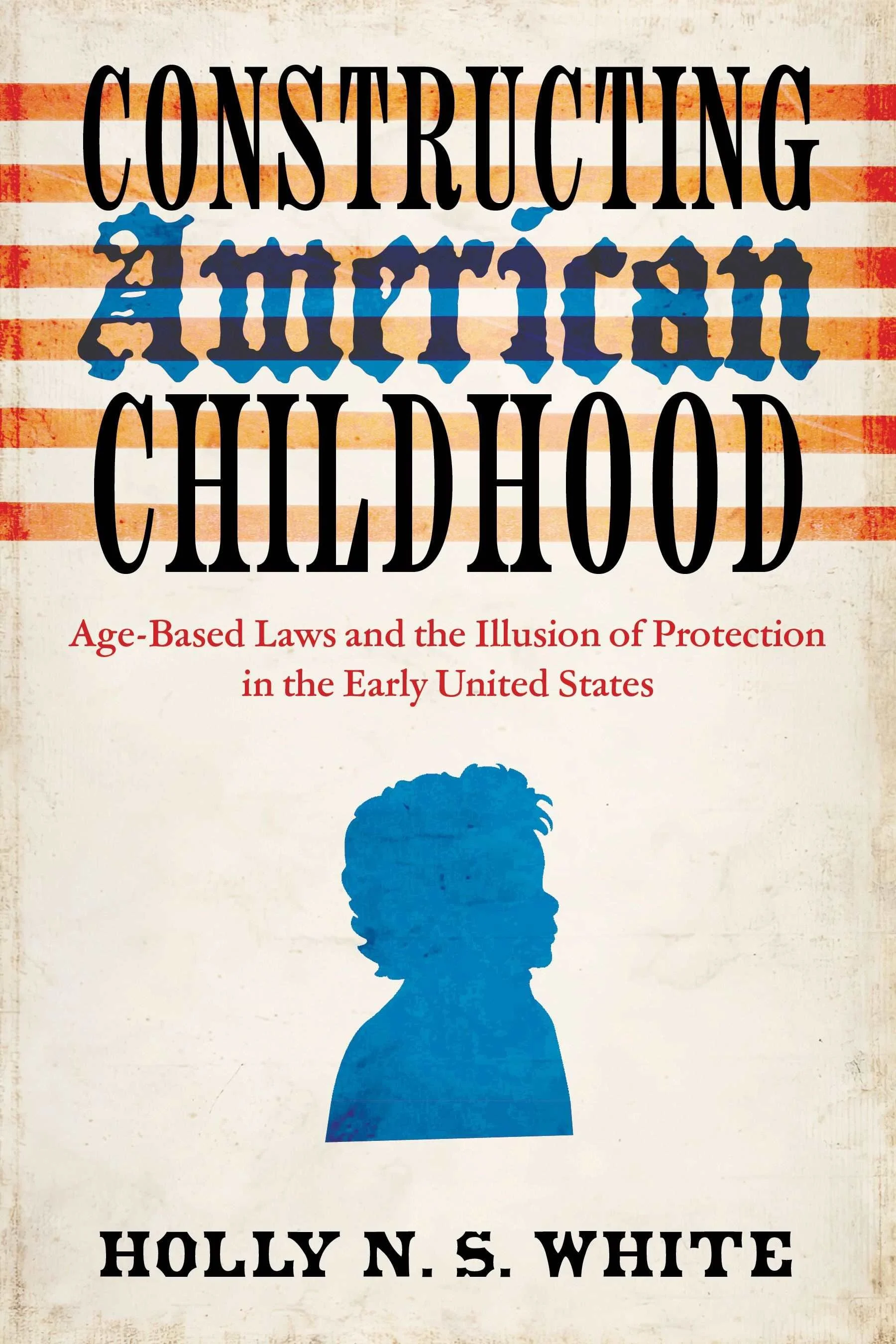
Holly N. S. White is the author of Constructing American Childhood: Age-Based Laws and the Illusion of Protection in the Early United States, which was released earlier this month. Holly is an Adjunct Professor in the History Department at William & Mary. Here’s Holly to introduce us to the early American legal history of childhood.
Tell us about your book in two or three sentences. What's the big story you're uncovering?
Constructing American Childhood uncovers how and why legislators used age-based laws to define childhood and adulthood in the early United States. But it’s not just a legal history; I incorporate children’s perspectives found in trial records, letters, and diaries to reveal how underage Americans continually challenged authority figures over early national definitions of childhood and adulthood. Constructing American Childhood also reminds us that children had, and continue to have, agency; when we exclude their perspective and experiences from histories of early America, our understandings of the past remain incomplete.
What first sparked your interest in this topic?
I first became interested in the history of age while doing archival research for my dissertation in 2010. I came across a letter written in 1808 from Williamsburg, Virginia between two teenage girls named Jane and Sarah. Jane mentioned that a different girl named Maria Moody was moving to Richmond (even back then, a relatively short distance away). Jane suggested that Maria was going to be disappointed in her social prospects in Richmond because “girls her age are considered as children.” After some digging, I figured out that Maria was 10 years old. I found the girls' discussion of how chronological age and identity could change depending on where they lived fascinating. From there, I naturally progressed to studying age-based laws and how they were implemented, negotiated, resisted, and enforced in the early national period.
What's one surprising or little-known detail you discovered in your research?
The age-based laws that we use today to define adulthood and intellectual ability in both civil and criminal law are the same ones that have been used for centuries. While we now have scientific studies that reveal how the brain develops and matures in relation to chronological age, we’ve done nothing to update the arbitrary ages first chosen centuries ago. For example, minimum marriage age is set by state law rather than at the federal level. In turn, there are four states that still have no minimum marriage age and so if they have parental consent, a child of any age can be married.
Why does this story matter for understanding the early American past or the present?
The American Revolution led to the creation of a representative government, but it also led to the creation of American childhood. To have a government comprising those who could “reason” and “consent,” you had to have a way to determine when someone gained those abilities. Age was a logical legal boundary to separate who was a child and who was an adult. But many legal children were not used to having their age matter when making choices over their own lives. By examining these moments of conflict between children and those attempting to enforce age-based definitions of adulthood, Constructing American Childhood complicates our understanding of the history of the early United States and the history of American childhood.
I think we often assume that by the turn of the twentieth century “childhood” had been legally, socially, and culturally redefined to better protect children. In reality, Americans passed age-based laws following the American Revolution to better control the young population. Over time, authority figures embraced the concept of protection because it justified their use of age to limit children’s abilities. However, this rebrand of age-based laws recast a critical moment in the history of American childhood as a positive good, rather than the contested power play it was.
If you could invite readers into one scene from your book, what moment would you choose and why?
The scene I would choose is in the introduction of Section 2 and is between fifteen-year-old Juliana Ruffin and her legal guardian, her brother Edmund. In 1822, she wrote him a letter essentially stating: “I’m going to get married” (to a much older man with children) “and I’d like your permission; but if you don’t agree, I’ll claim my rights as ward and choose another guardian that will.” In the end, she does exactly that. What I love about the example is that it shows how aware Juliana was of her legal rights as a ward, which she asserted to get what she wanted: the ability to marry while underage.
What's one historical source, artifact, or place you'd recommend for readers who want to explore this topic further?
This is a hard one—age is everywhere in the historical archive. From court records to church records, laws, institutional records, personal letters and diaries, inventories, labor contracts, newspaper advertisements, literature, popular culture… the list is really endless. So perhaps instead of suggesting one source to explore this topic further, I’d challenge readers to look for age every time they encounter a source or topic from the past.
Where can readers learn more about your work?
The best place to find up-to-date information about my work is via my Instagram page: @thechildishprofessor! There you can find information about my new research on children in the American Revolution, short videos about the history of childhood in early America, and some really cool new project collaborations that will include free elementary and middle school teacher resources. Please check it out, give me a follow, and share with your friends!

Order Constructing American Childhood
🎧 Go Deeper
Explore children’s experiences in early America with these episodes of Ben Franklin's World:
🎧 Episode 295: Ibrahima Seck, Whitney Plantation Museum
🎧 Episode 257: Catherine O’Donnell, Elizabeth Seton An Early American Life
🎧 Episode 367: The Brafferton Indian School, Part 1
🎧 Episode 368: The Brafferton Indian School, Part 2: Legacies