Louis Masur, A Journey North
Summer is the season for vacations; maybe you have a trip planned or are reminiscing about travels past. If so, you’re experiencing something similar to two American founders, James Madison and Thomas Jefferson. They too traveled and remembered those journeys fondly. But, as with much of history, there’s way more to the story. Today’s guest explains it all in a book slim enough to squeeze into your summer reading (or packing) list.
To tell us more about Madison and Jefferson’s trip in the summer of 1791 is today’s guest, Louis Masur. Louis is the Board of Governors Distinguished Professor of American Studies and History at Rutgers University. Today he shares details of his most recent book, A Journey North: Jefferson, Madison, and the Forging of a Friendship. Here’s Louis to tell us more about this summer trip.
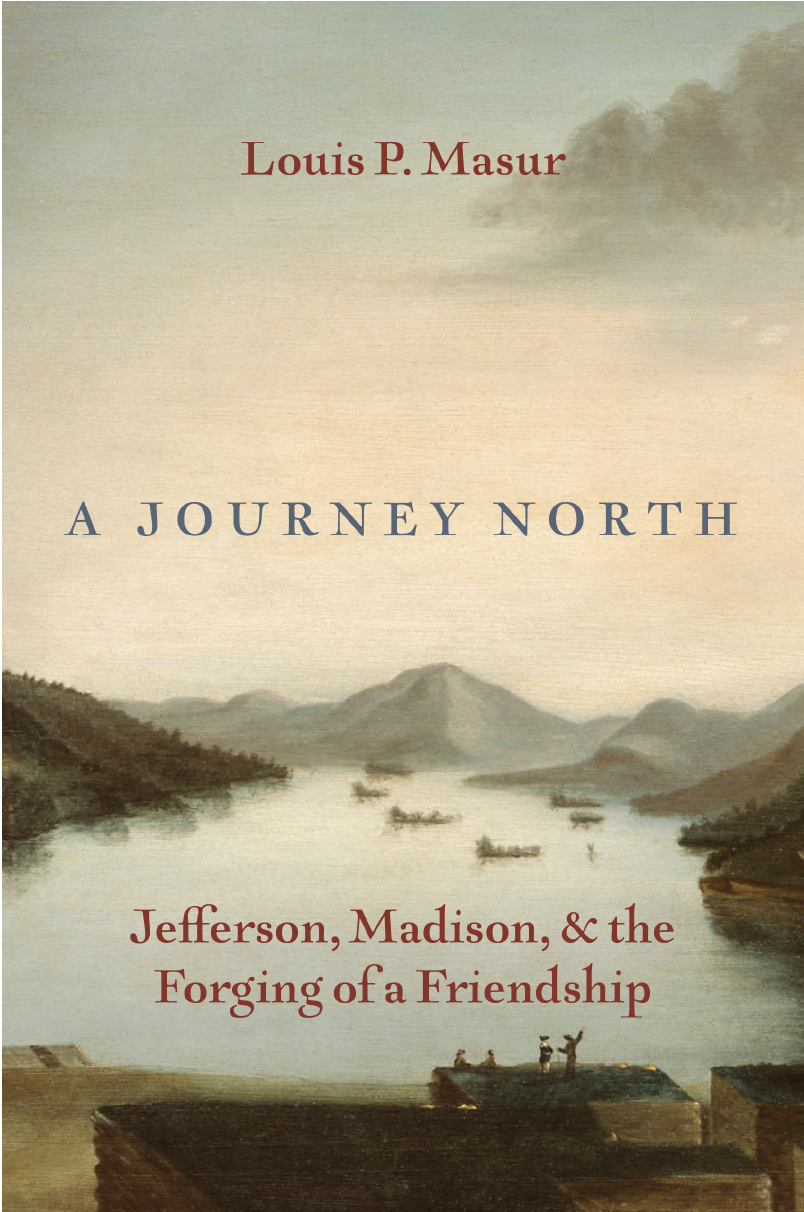
Tell us about your book in two or three sentences. What's the big story you're uncovering?
Between May 21 and June 16, 1791, Thomas Jefferson and James Madison traveled together through parts of upstate New York, Vermont, Massachusetts and Connecticut. The journey encompassed 920 miles and deepened their friendship, the most important political partnership in American history. Although political opponents saw partisan designs in the trip, they embarked for the purposes of what Madison called “health, recreation, and curiosity.” The journey allows us to see the two men less as public figures and more as companions enjoying themselves as they toured a landscape largely unfamiliar to them. Both men had occasion to recall the trip toward the end of their lives.
What first sparked your interest in this topic?
Much of my work focuses on discrete moments (I’ve published books on a year, a photograph, and a record album), and I was struck by the trip when I first read about it. Very little had been written about the excursion, in part because of the limitations of the sources, but there was enough—partial journals kept by both men, letters, lists—to narrate the tale.
What's one surprising or little-known detail you discovered in your research?
There are many surprises, but one that struck me was learning about Jefferson’s obsession with Native American languages. Toward the end of the trip, on Long Island, he interviewed several members of the Unkechaug tribe and compiled a list of their vocabulary on the back of an envelope. He continued to collect Indian vocabularies for the next two decades and envisioned producing a volume of comparative vocabularies.
Why does this story matter for understanding the early American past or the present?
The journey north allows us to see Jefferson and Madison in a new light and reminds us that they were Enlightenment figures as interested is such topics as the Hessian fly (which was devastating wheat crops), the sugar maple tree (which they saw as a source for the domestic production of sugar), and revolutionary battlefields (they walked the grounds at Saratoga and Bennington) as political developments.
If you could invite readers into one scene from your book, what moment would you choose and why?
On June 1, 1791 they met a Black farmer named Prince Taylor. Madison wrote about the encounter. Taylor had served during the Revolutionary War, owned land, and had employed white workers. It is likely that James Hemings, Jefferson’s enslaved valet and chef, was also present. I devote a chapter to thinking about that encounter and to tracing Jefferson and Madison’s attitudes toward race and slavery.
What's one historical source, artifact, or place you'd recommend for readers who want to explore this topic further?
Madison and Jefferson exchanged over 1,200 letters between them. One of the more remarkable was Jefferson’s call for Bill of Rights. Writing from Paris on December 20, 1787, he insisted that the people are entitled to a bill of rights. Readers should go to Founders Online where they can search the correspondence not only of Jefferson and Madison but also Washington, Adams, Hamilton, and Franklin. It’s a remarkable resource that allowed me to continue to research when the archives were closed.
Where can readers learn more about your work?
My website is www.louismasur.com. Check there for information about my books, essays, and announcements of lectures both online and in person.
🎧 Go Deeper
Learn more about traveling in early America with these episodes of Ben Franklin’s World
🎧 Episode 077: Rinker Buck, The Oregon Trail
🎧 Episode 239: Joseph Adelman, Post & Travel in Early America
🎧 Episode 436: Matthew Keagle, Fort Ticonderoga & Henry Knox’s Noble Train of Artillery