Anna O. Law, Migration and the Origins of American Citizenship
Scholars often work for years, or even decades, on their books. They sort through documents, organize reams of notes, and begin drafting chapters with copious footnotes. By the time a book has been peer reviewed, edited, and published, it often reflects many years of work. As you might guess, this long process makes a book’s timeliness difficult to plan. But occasionally new scholarship is released at just the right moment to help readers understand contemporary issues.
This is the case for Anna O. Law’s new book, Migration and the Origins of American Citizenship: African Americans, Native Americans, and Immigrants, which was released last month. With immigration and citizenship in the news, Anna’s work provides critical context for our current moment. Anna is Associate Professor of Political Science and the Herbert Kurz Chair of Constitutional Rights at The City University of New York, Brooklyn College. Here’s Anna to tell us more about the long history of migration and citizenship in America.
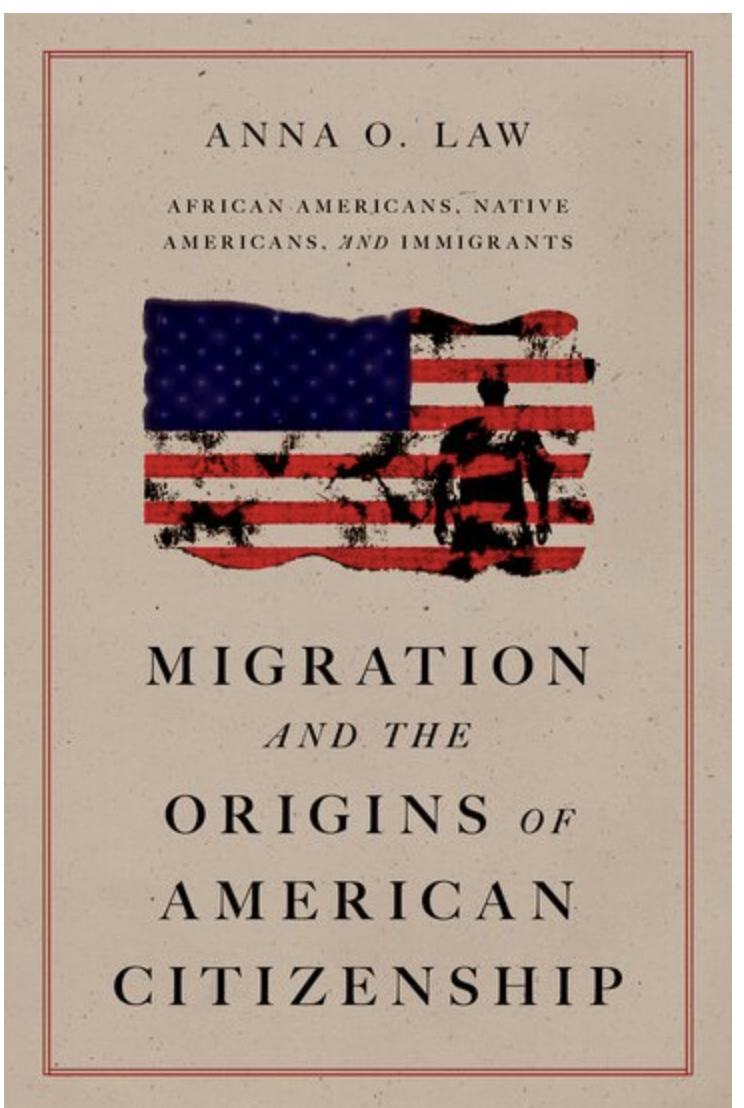
Tell us about your book. What's the big story you're uncovering?
Migration and the Origins of American Citizenship is the story of how the U.S. founders regarded the freedom of mobility, and its corollary the ability to remain, as fundamental to personal liberty (for most Europeans). But through laws, first at the colonial level, then continued by states in the early republic through the late nineteenth century, these same rights were denied to poor people, free and enslaved Africans, and African Americans.
For Native Americans, lawmakers and many in the public regarded Indigenous peoples’ ability to remain on their ancestral lands as relational to European settlers’ desires to own and occupy that same land. Americans also conceived of Native Americans’ presence in contested areas as zero-sum, rejecting the idea that Native nations could peacefully and productively coexist alongside white Americans. That rejection of the possibility of a multiracial nation led to the violent deportation of over 80,000 Native peoples in the 1830s to “clear” land for white settler families.
What first sparked your interest in this topic?
Sixteen years ago, when I began research on this book, I wanted to know whether the existence of the institution of slavery affected voluntary migration laws and policies in the US. I knew I was on the right track when halfway through my book process, the 1619 essays came out. I initially set out to write a book about voluntary migration. Specifically, I use the lens of federalism to figure out where is the location of the dividing line between two layers of authority in migration where the national and state/local governments share power. Answering that question about the colonial, early republic, and antebellum eras necessitated the inclusion of African-American and Native history because both histories affect and intersect the policy history of voluntary migration.
What’s one surprising or little-known detail you discovered in your research?
I knew that the English North American mainland colonies offered free land to recruit voluntary migrants and Europeans received land just for migrating, but I didn’t know that the headright system that began in Virginia also offered land to those who could pay for the migration of others. That policy incentivized abuses. For example, wealthy planters amassed land by importing enslaved Africans, even though the importation of enslaved people was a violation of the Magna Carta. That document stipulated that servants must be held to limited periods of contracted labor. Thus, from the beginning, forced migration was intertwined with voluntary migration.
Why does this story matter for understanding the early American past or the present?
The history of colonial and early republic migration laws and policies incentivizing or restricting different groups of migrants from coming contradicts the official story presented by the Department of Homeland Security. That account claims the U.S.’s borders were functionally open until the federal government started enforcing borders in the late nineteenth century. Eliding colonial and early republic migration laws hides which groups were given a leg up with laws and policies, and who was restricted from coming and staying.
In the case of Native Americans who are not migrants but original landowners and occupants, the “official story” of migration erases them completely. As Indigenous peoples were dispossessed of their lands, the U.S. government labeled these areas as “public lands” and offered them to overseas Europeans and white migrants already in the U.S. alike as incentives to migrate.
If you could invite readers into one scene from your book, what moment would you choose and why?
I would direct readers to the Revolutionary War era in the third chapter where I explore the question of how factors outside of the formal Constitution drafting process defined who belonged. For example, migration patterns (by the post-Revolutionary War period the larges bound labor group was enslaved Africans), Revolutionary War military tactics of the patriots and British, and the American press all sent messages to Americans about who was included in the civic community. The sorting of who could be a rights-bearing member of the community did not take place only in laws and the Constitution, but in these practices. In 1790 Congress passed the first federal Naturalization Act, which restricted citizenship to “free white persons.” That law was a ratification and reification of racial formation processes that had been underway in the colonial period.
What's one historical source, artifact, or place you'd recommend for readers who want to explore this topic further?
For those who want to understand the migration patterns, laws, and policies regulating the many kinds of migration, including the forced migration of enslaved people in early America, I suggest a trip to Charleston, South Carolina to the International African American History Museum. The museum is built atop Gadsden's Wharf, the site where between February 1806 and early 1808, “as many as 45,000” captives disembarked at that dock from “approximately 270 voyages.” Enslaved migration is certainly not “immigration” because that term implies consent that was totally absent—but enslaved migration (and the institution of slavery) directly affected the content and trajectory of voluntary migration and citizenship laws.
Where can readers learn more about your work?
This Q&A has been so much fun. Thank you, Sally Franklin’s Bookshelf! Readers can visit my website annaolaw.com to learn about me, find upcoming podcasts or talks for Migration and the Origins of American Citizenship, and links to order the book in ebook/paperback/hardback from Oxford University Press. They may especially be interested in the Q&A there at the end of the book page. Readers may also follow me on Bluesky at @unlawfulentries.bsky.social.
You can also buy Migration and the Origins of American Citizenship at the Ben Franklin's World Bookshop.

🎧 Go Deeper
Explore more about the relationship between Native American nations and the U.S. federal government with these episodes of Ben Franklin's World:
🎧 Episode 286: Elections in Early America: Native Sovereignty
🎧 Episode 362: David W. Penney, Treaties Between the US & American Indian Nations
🎧 Episode 323 Michael Witgen, American Expansion and the Political Economy of Plunder
💬 Join the Conversation
Has learning about the early American past ever changed your perspective on a contemporary debate? Tell us about it.
📩 Hit Reply to share your thoughts. 💬 Join the conversation in our Listener Community.
❤️ Support Ben Franklin’s World
You power this newsletter—and the effort to keep history in the headlines. 👉 Support our work
📘 Affiliate Disclosure
Links to books in this email are affiliate links through Bookshop.org. This means that each purchase supports local, independent bookstores and helps sustain Ben Franklin’s World at no additional cost to you. Thank you for supporting history and the communities that keep it alive.