Ann Beebe, Anne Bradstreet in Context
Today we’re interviewing Ann Beebe, author of Anne Bradstreet in Context: The Life and Work of a Colonial American Poet. Ann is a Professor and Chair of the Department of Literature and Languages at the University of Texas at Tyler.
Here’s Ann to tell us more about her exciting new work on one of colonial America’s most notable poets, Anne Bradstreet.
Tell us about your book. What's the big story you're uncovering?
Many people today share false assumptions about colonial history, especially the Puritans and Massachusetts Bay Colony. And then we base our reading of colonial texts, like the poetry of Anne Bradstreet, on those shaky foundations.
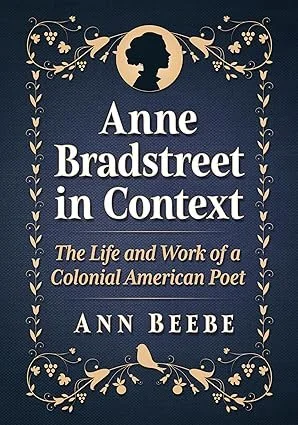
Anne Bradstreet in Context: The Life and Work of a Colonial American Poet draws on primary documents (colonial records, letters, manuscripts), as well as the incredible work of historians of the seventeenth century, to illuminate the religious, political, social, and literary world of Anne Dudley Bradstreet (1612-1672) in order to provide a strong scaffolding for readers to appreciate and analyze her poetry.
What first sparked your interest in this topic?
When I was asked to submit a proposal for a second book, I knew I wanted to take the opportunity to create a practical resource for students and teachers of seventeenth-century colonial literature. I wrote the book that I needed years ago as a junior faculty member in a small department, who was responsible for teaching all 1630-1870 American literature courses. My training in eighteenth and nineteenth century literature and history was strong, but before writing this book, I had not had the chance to delve into the seventeenth century in a meaningful way.
Moreover, I firmly believe that literary interpretations of texts are richer and more relevant when contextualized in the time period in which they were written. So in Anne Bradstreet in Context I set myself the challenge to write a book–part literary analysis, part biography, part history, part reference, part textbook–that readers in the twenty-first century would find helpful as they read and analyze literary texts from the seventeenth century.
What's one surprising or little-known detail you discovered in your research?
This is a difficult question to answer since I was constantly turning up information about the Puritans and Massachusetts Bay Colony that I never learned in school (kindergarten through PhD).
I think the topic that forced me to be more deliberate about examining the assumptions I brought to the project would be the life of Bradstreet’s sister, Sarah Dudley Keayne Pacey (1620-1659). All the surviving documents surrounding her marriage, her husband’s desertion, her excommunication, her divorce, and her second marriage were written by others – her husband, her father-in-law, her father, ministers, and historians. Her own account of these events is not available to us.
Why does this story matter for understanding the early American past or the present?
The generation of 1776 did not spring out of thin air. They are the literal and metaphorical great-grandchildren of the members of the Great Migration (1630-1642). The life and poetry of Anne Dudley Bradstreet, and the influence of the Dudley-Bradstreet family on the settlement of Massachusetts, Connecticut, and New Hampshire, can provide clarity on the forces that shaped the Revolutionary generation as we head into the 250th anniversary of the Declaration of Independence.
If you could invite readers into one scene from your book, what moment would you choose and why?
Anne Bradstreet’s The Tenth Muse Lately Sprung Up in America (1650) is the first book of poetry published by a resident of colonial Massachusetts. Yet Bradstreet did not seek out a publisher, select the poems for the collection, or edit the book; her brother-in-law, John Woodbridge, is responsible for the book’s publication in London. I would like to have been present when a copy of the printed book was given to Bradstreet. We might speculate on her complicated feelings based on a subsequent poem, “The Author to Her Book.”
What's one historical source, artifact, or place you'd recommend for readers who want to explore this topic further?
None of Anne Bradstreet’s houses have survived. Indeed, we don’t even know her grave’s location. But I would still recommend visits to Ipswich and Andover, Massachusetts. Anne Bradstreet and her husband, Simon Bradstreet (1603/4-1697), were crucial to the founding of both towns. And I would recommend the digitized “Andover Manuscript,” the only known example of Anne Bradstreet’s handwriting.
Where can readers learn more about your work?
Anne Bradstreet in Context: The Life and Work of a Colonial American Poet can be found on the publisher’s website, as well as at Bookshop.org, independent booksellers, and most major online retailers. I will also be participating in the History Explorers Club on February 18, 2026. (Click here to learn how to join the History Explorers Club)

Go Deeper
Explore the work of poets, artists, and authors in early America with these episodes of Ben Franklin's World:
Episode 377: Ade Solanke, Phillis Wheatley & the Playwright
Episode 423: Zara Anishanslin, The Forgotten Artists of the American Revolution
Episode 201: Catherine Kelly, Art, Politics, and Everyday Life in Early America
Episode 145: Rosemarie Zagarri, Mercy Otis Warren and the American Revolution
Join the Conversation
What piece of poetry or art from early America do you find compelling today, and why?
Join the conversation in our Listener Community.
Support Ben Franklin’s World
You power this newsletter—and the effort to keep history in the headlines. Support our work
Affiliate Disclosure
Links to books in this email are affiliate links through Bookshop.org. This means that each purchase supports local, independent bookstores and helps sustain Ben Franklin’s World at no additional cost to you. Thank you for supporting history and the communities that keep it alive.